Featured

Are We Better Than Boxed Wine?

Well well well if it isn’t the consequences of my own actions…

I launched a blog then took on a ton of new responsibilities and alas here I am a year later ready for my re-launch. Let’s try this with some sense of regularity, shall we? It’s just blogging (Cara’s Version).
I am excited to announce that with the relaunch I have kicked off the Wine Guide, which I will continue adding to. Let me know what wines you’d like to see up there! I started with some basics but there are so many I can cover.

I spent a while thinking about what my first blog back would be. I wanted it to focus on the reason I launched this blog – so you can learn some cool stuff about fermented grape juice and have some great anecdotes to use to change the subject when your family starts talking about politics at dinner.

Wow I feel like one of those recipe blogs you find and you have to scroll for 20 minutes reading someone’s life story when you just wanted to know how many cups of chicken broth you need… So without further ado, the reason I gathered you here today is to collectively ponder:

Are we better than boxed wine?

The short answer is: no.

It feels like every time I go into the liquor store I see wine in some new type of vessel. Now you can choose between cans, boxes, screw tops, old faithful (cork), etc. when deciding what type of wine drinker you’re going to be this week. 

Historically wine is put into a bottle and sealed with a cork. The cork used traditionally comes from a cork tree (Quercus suber), which are most successfully grown in Portugal and Spain. I had the opportunity to see one when I worked in Napa and it feels just like a cork does when you touch it. The process of getting cork from a tree and turning it into a wine bottle cork is amazing and time consuming. If the cork comes into contact with chlorine in some form there can be a chemical reaction which causes 2,4,6-trichloroanisole (TCA) to grow, which can result in a wine being “corked.” Corked wine is generally easy to spot as it has the unfortunate trait of smelling like “wet dog.” This is why it is so important to smell your wine when opening a bottle with a traditional cork. 

Some wine companies have begun using synthetic corks for their wines as a way to keep that traditional look, while having more quality control over their product. So if you open up a bottle and it looks like cork but is more like plastic, that is synthetic. 

For some reason people look down on the use of screw cap wines. I am #TeamScrewCap for so many reasons. How many times have you brought a bottle of wine somewhere only to discover you don’t have a bottle opener? I guess you’re “screwed”…but you wouldn’t have been if you brought a screw cap wine. Avoid tragedy and buy screw cap wines!
Screw cap wines are widely used in New Zealand and Australia and are constantly growing in popularity in many other regions. I am here to break the news to you that screw caps vs. cork makes no difference in the quality or taste of your wine. Expensive wine brands will use cork as long as the consumer believes authentic cork to be a signature of quality, which ironically is the most temperamental option. Say it with me “screw caps on wines don’t indicate wine quality!” Taylor Swift saying “your roommates cheap-ass screw top rose” is working against my cause, but I forgive her.

Yes, I will find a way to incorporate Taylor Swift into almost any conversation I have and this blog is no exception. 

Am I saying “blog” too much?

Now to move beyond the bottle…

Wines in a can – can they produce quality wines? Sure! You know my stance on the snobbery of wine culture…but really why can’t I participate in the tailgate just because I don’t drink beer? What if glass isn’t allowed where I am? Am I supposed to be PARCHED? 

The main problem I’ve found with cans is that some wines do not vibe with the flavor cans can impart. Cans are inherently for cold beverages, so it can make reds tricky in a can. If the flavor of the white or rose wine is strong it can taste metallic when drinking. My advice when opting for a can is to pick one from a higher shelf. In this case the quality matters because you truly can taste it if you are drinking it right out of the can. Alternatively, you can be classy and pour it into a glass or cup from the can and the flavors will not have that metallic hint. Although, that kind of defeats the purpose of the can in my opinion but you do you!

Lastly we will talk about my baby, my first love, my reason for living (just kidding) – boxed wine.
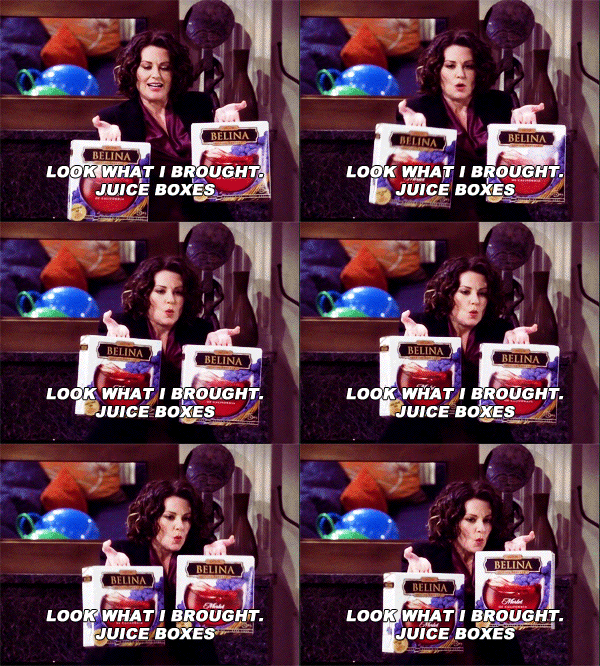
When I was 21 years old interning for a boutique PR firm that specializes in Champagne and Burgundy I would go to work and pour 2003 Blanc de Blanc Champagne and be able to try some of the rarest wines in the world. Then I would go hangout with my friends on the weekend and “slap the bag” with some Franzia white wine. The juxtaposition of my life at the time still makes me smile because it is the time I was falling in love with the world of wine. It was also the time where I started thinking, can’t we have both? Why can’t I love a 2015 single vineyard Napa Valley Cabernet Sauvignon and also love Bota Box Red Wine Blend?

The reason boxed wine is cheaper is because the companies are saving money on overhead materials by not having to buy the bottles, corks, screw tops, and machinery to make all of those things come together. The wine quality in boxed wine can be good (not great, I’m not that far removed from reality). The wine used in boxes is often produced in massive quantities and using grapes from many different vineyards within one box. However, that practice is also found in a lot of the wine bottles you buy – two buck chuck, big name cheap brands, etc. I think part of what is missing in those boxed wines is the complexity of flavors that can come from single vineyard, or barrel-aged wines. 

So what’s the consensus? Drink wine out of whatever vessel you want. Next time you second guess bringing boxed wine to a party, don’t. Use it as a chance to educate your friends on different wine vessels. Maybe their expensive Chardonnay will be corked and they’ll come crawling to you for some of your wine.

Thank you for sticking with me during my time away and thanks for continually giving me inspiration during that time to continue with this hobby that brings me such joy.

Let me know what kind of ramblings you’d like to see next. Until then, cheers!

Pinot Noir

Other Names

Pinot Nero, Pinot Negro, Spätburgunder, Blauburgunder.

Popular Regions

  • France (Burgundy, Champagne)
  • United States – Oregon (Willamette Valley)
  • United States – California (Russian River Valley, Santa Barbara, Santa Cruz)
  • Australia (Adelaide Hills, Yarra Valley, Tasmania)
  • New Zealand (Central Otago, Marlborough, Martinborough)

Does Vintage Matter?

Pinot Noir is a lighter red wine so generally the younger the wine the better. 

Tasting Notes

Pinot Noir is often light to medium bodied and high in acidity with flavors of cherry, raspberry, earth, forest floor, and mushroom.

Something to Say to Impress People

“Did you know that sparkling wine labeled Blanc de Noir is made of 100% Pinot Noir grapes?”

Budget Buy

  • The Pinot Project (~$12)
  • Ironstone (~$10)

Normal Buy

  • J. Lohr (~$22)
  • La Crema (~$25)

Splurge Buy

  • Domaine Forey Pere & Fils (~$40)
  • Lange Reserve (~$39)

If you like this wine than you should try

  • Gamay
  • Grenache
  • Zinfandel

RED Wine Season (Cara’s Version)

Happy Hallo-wine!

As rosé season comes to an end, it’s time we explore the world of red wines. A question I get asked a lot is how to become a red wine drinker when you usually gravitate towards sweet wines or light white and rosé wines. Entering the world of red wine doesn’t need to be a spooky experience, so let’s usher in the season of RED (wine and Taylor Swift).

Getting overwhelmed with the wine selections at a liquor store is common practice, even for the most experienced wine aficionados. An easy trick is to learn a couple of good regions for the varietal you’re interested in trying and then just picking a wine based on region and your price range. Below I will list some great starter red wines and the best regions for them. I listed the wines from lightest to heaviest. Also, since it’s Halloween I’ll throw in a candy pairing recommendation too.

Pinot Noir

My favorite wine to recommend as a starter red wine for a few reasons. One reason is that it’s very light bodied, making it a nice transition from white wines. If you really want to ease in you can put your Pinot Noir in the fridge for 20 minutes before you drink it. The second reason is trying something so light will help you learn if you like lighter reds or if you might want to try something heavier. The final reason is that the taste of Pinot Noir can change depending on the region it’s from, with the fruitier Pinot Noirs coming from Sonoma County and earthier Pinot Noirs coming from Burgundy and Oregon.

Pinot Noir Regions: Burgundy, France; Willamette Valley, Oregon; Sonoma County & Santa Barbara County, California, New Zealand, Italy and Germany

Pinot Noir Candy Pairing: Reese’s, Hershey’s Milk Chocolate, Starbursts

Petite Sirah

Petite Sirah (or Petite Syrah) is a fun one because it’s not one that people usually go for but it’s fruity and on the lighter side. Try this next to a Pinot Noir and see if you can notice the nuances and the differences between them. Like Pinot Noir you can also put this in the fridge for 20 minutes before drinking it.

Petite Sirah Regions: California (Napa, Sonoma, Mendocino, and Lodi)

Petite Sirah Candy Pairing: Dark Chocolate

Zinfandel

*Not* White Zinfandel, as we’ve discussed. Zinfandel is great because it can be on the fruitier side, which can be interpreted as slightly sweet compared to some of the bigger and drier reds. 

Zinfandel Regions: California (Notably: Russian River Valley, Dry Creek, Lodi, Napa, and Paso Robles)

Zinfandel Candy Pairing: M&Ms, Lollipops

Merlot

Personally, I love Merlot. It is medium-bodied, easy to drink, and pairs well with a lot of food. Merlot has had an unnecessarily bad reputation because of some terrible movie in which the main character kept exclaiming his hate for the varietal. I am here to say #JusticeForMerlot!!

Merlot Regions: Bordeaux, France; Napa, California; Chile; Australia

Merlot Candy Pairing: Kit Kats

Cabernet Sauvignon

Finally, we arrive at the king of reds – Cabernet Sauvignon. It is one of the most widely planted and well-known grapes in the world, and that’s because it’s delicious. This is a full-bodied dry red wine, so if the Pinot Noir wasn’t quite doing it for you this might be your perfect choice. It is a scientific fact that you are 25% cooler when you order “a heavy Napa Cab” at a restaurant.*

*Okay maybe not, I was never good at science.

Cabernet Sauvignon Regions: Bordeaux, France; Napa, California; Australia; Tuscany, Italy; South Africa

Cabernet Sauvignon Candy Pairings: Snickers, Reese’s

Now it’s time for some boo-s! Drink & Eat responsibly out there!

Wine 101: Basic Wine Terms

Welcome to my Wine 101 Series! I will be sprinkling in Wine 101 articles to aid in your learning process. My goal here is to help you understand basic wine terms. If that helps you feel classy and smart next time you’re drinking wine with friends, well that’s a nice bonus. 

Be honest…how many of you have swirled a glass of wine and said “wow that wine has nice legs” because you couldn’t think of anything else to say? 

Pro Tip: Don’t comment on a wine’s legs, it shows you’re a novice right off the bat. No shame in the leg game, but we’ll save that for later.

Body: Body is essentially how the wine feels in your mouth when you drink it. Is it light? Is it heavy? Understanding the body of the wine will help you identify what kinds of wines you like. Ever hear someone say “I LOVE a big Napa Cab” ? Well, other than sounding a little pretentious, that means that this person should be looking for full-bodied wines. Next time you take a sip of a wine, swirl it around in your mouth and try to pay attention to the “weight” and structure of it.

Corked: Corked wine is also known as a wine impacted by cork taint. Essentially a chemical reaction caused by TCA (trichloroanisole) makes the wine smell like wet or soggy cardboard. The wine will taste flat usually too. This won’t harm you to drink, but it’s never worth drinking a corked bottle. You will usually only experience this with bottles with natural cork, rather than synthetic or screw caps. This is why it’s important to smell your wine before tasting it! Also, it makes you look cool and sophisticated. 

Quick Story Time: Back in 2015, before we lived in California, we took a trip with friends to San Francisco and decided to do a wine tour in Sonoma. We were in our early-mid twenties and weren’t taking the experience too ~seriously~ (we were basically just trying to get drunk). Our Tour Guide/Sommelier wasn’t too impressed with us and was trying his very best to teach us. He taught us about corked wine earlier in the day. At our last winery visit of the day we were giggling and enjoying ourselves and one of my friends took a sniff of the new glass of wine they poured and said “I think this wine is corked.” The Somm rolled his eyes, but wanting to get rid of this drunk group he took a sniff, and to his surprise the wine WAS corked! He was impressed and quickly opened a new bottle. All this to say, trust yourself. Sometimes the novice drunk 23 year old can call something out in a wine that is 100% accurate. In other words…

Earthy: If a wine tastes earthy it doesn’t necessarily mean it tastes like dirt. Earthy can mean that the wine tastes dry with some kind of earth component (soil, forest, mushroom, etc.). Often this is reflective of the region and terroir that the wine is from – more on that later.

Finish: The Finish of the wine is all about how long the flavor of the wine stays with you. A long finish is usually indicative of a good wine (for the most part) that has some complexity and age. If the wine taste doesn’t linger for very long after you take a sip that usually means it’s a short finish.

Legs: *Sigh* Like I mentioned above, I know you’ve all heard someone say “this wine has great legs.” Truly nothing shows that someone knows nothing about wine more than this comment. I’m sorry to say it, but it’s better that you hear it from me. The legs of the wine are the tear-shaped droplets inside the glass that drip down after swirling the glass. The legs can indicate that the wine is high in alcohol. Aside from that, it doesn’t mean much, so let’s move on.

Oak: A lot of wine can be aged in oak barrels, which can impart flavors of vanilla, caramel, honey, other “toasty” flavors, etc.. For white wines you’ll mostly see this in Chardonnay. Oak is more common in red wines. Some winemakers will use oak chips instead of oak barrels, since the cost of new barrels can be so high. Barrels really only have a life span of 1-3 years. 

Tannin: Have you ever taken a sip of black tea with nothing in it and had that astringent and somewhat bitter taste in your mouth? That is tannin. Tannin is naturally occurring in grape skins (also tea leaves and other foods). Because the tannin comes from the skin of the grape you will mostly only have tannins in red wines, since they are fermented with their skins*. Wines with high tannins usually mean they can age for a while. Whether you like tannic flavors or not can be another good indicator on what kind of wines you like.

*I will talk more about the fermentation process in the future. 

Terroir: Terroir is one of my favorite wine terms because it means so much, yet it can also be kind of vague. Terroir encompases all of the environmental characteristics that affect a wine (i.e. soil, climate, sun exposure, elevation, etc.). Terroir is what makes wines from each region have the same general characteristics, while also letting each winemaker have a sense of individuality. I guarantee talking about the terroir of a grape will be much more impressive than talking about the legs.

Varietal: Varietal means wines that are made from a specific grape (Chardonnay, Cabernet Sauvignon, Sauvignon Blanc, Merlot, etc.). This will tell you what grape(s) you are actually drinking in your glass. If a bottle says Chardonnay, that means the bottle you are consuming is either MOSTLY or ENTIRELY Chardonnay. Depending on the region and the wine laws in place, sometimes a wine bottle can be labeled as Chardonnay but also have a small percentage of another varietal in it like Semillon or Chenin Blanc. Wine laws are a nightmare because they are not universal. More on that to come when I have the energy to tackle that mess.

Vintage: Vintage is the year that the grapes were harvested. If you buy a bottle that says “Cabernet Sauvignon 2015,” that will mean that the grapes in that bottle were grown and harvested in 2015. I will get into good vintages for popular regions later on. For starters just stick to the rule that most white and rosé wines should be consumed young (the wine should be young, you don’t have to be).

Hopefully this article will help you look slightly cooler the next time you’re drinking wine while out. Until next time!

Grab a Fork & Pop the Cork!

Welcome to Grape & Grub—where I teach you how to become a savvy sipper without breaking the bank! This blog has been something I’ve wanted to do for years and to finally be launching it feels like a dream come true. This is a space where no question is embarrassing or off limits and where you can drink your boxed wine (and maybe accompany it with something on the dollar menu) without judgement. 

You may be asking yourself: What are this girl’s credentials? Well, my professional experience in wine includes working for a boutique wine Public Relations firm, working in Sonoma and Napa County for a large Wine Company in Hospitality, and Wine Club. I also took and passed Level One of the Certified Sommelier program. While I’m glad to have those notches in my belt, I decided my passion aligns more so with Wine Education than Wine Service and so I recently took and passed the WSET program (Wine & Spirits Education Trust) Level 2. 

My non-professional experience? Nine years of boxed wines, twist caps and corked trial and error paired with an appetite for learning (and tacos…and pizza…and sushi—okay you get the point!)

All this to say, I’m here to share my wine knowledge with people without the pretense. Let’s be real, we’re talking about fermented grape juice here. We should all be able to enjoy our wine without worrying how you’ll have enough money left to pay the cable bill. Wine should be FUN! *Cue Kyle Cooke from Summer House energy*

Remember! no wine preference is trash*, and there is no food out there that can’t be paired with wine, even my beloved Taco Bell. This blog will focus on basic wine questions, wine recommendations, food & wine pairing, and more**.

*But I do reserve the right to judge your White Zinfandel

**Potentially embarrassing stories

So drop your questions and any topics you’d like me to discuss below. I can’t wait to begin this journey with you all. By now, it must be 5:00 somewhere, so grab your fork & pop the cork, it’s wine time.