Well well well if it isn’t the consequences of my own actions…
I launched a blog then took on a ton of new responsibilities and alas here I am a year later ready for my re-launch. Let’s try this with some sense of regularity, shall we? It’s just blogging (Cara’s Version).
I am excited to announce that with the relaunch I have kicked off the Wine Guide, which I will continue adding to. Let me know what wines you’d like to see up there! I started with some basics but there are so many I can cover.
I spent a while thinking about what my first blog back would be. I wanted it to focus on the reason I launched this blog – so you can learn some cool stuff about fermented grape juice and have some great anecdotes to use to change the subject when your family starts talking about politics at dinner.

Wow I feel like one of those recipe blogs you find and you have to scroll for 20 minutes reading someone’s life story when you just wanted to know how many cups of chicken broth you need… So without further ado, the reason I gathered you here today is to collectively ponder:
Are we better than boxed wine?
The short answer is: no.
It feels like every time I go into the liquor store I see wine in some new type of vessel. Now you can choose between cans, boxes, screw tops, old faithful (cork), etc. when deciding what type of wine drinker you’re going to be this week.
Historically wine is put into a bottle and sealed with a cork. The cork used traditionally comes from a cork tree (Quercus suber), which are most successfully grown in Portugal and Spain. I had the opportunity to see one when I worked in Napa and it feels just like a cork does when you touch it. The process of getting cork from a tree and turning it into a wine bottle cork is amazing and time consuming. If the cork comes into contact with chlorine in some form there can be a chemical reaction which causes 2,4,6-trichloroanisole (TCA) to grow, which can result in a wine being “corked.” Corked wine is generally easy to spot as it has the unfortunate trait of smelling like “wet dog.” This is why it is so important to smell your wine when opening a bottle with a traditional cork.
Some wine companies have begun using synthetic corks for their wines as a way to keep that traditional look, while having more quality control over their product. So if you open up a bottle and it looks like cork but is more like plastic, that is synthetic.
For some reason people look down on the use of screw cap wines. I am #TeamScrewCap for so many reasons. How many times have you brought a bottle of wine somewhere only to discover you don’t have a bottle opener? I guess you’re “screwed”…but you wouldn’t have been if you brought a screw cap wine. Avoid tragedy and buy screw cap wines!

Screw cap wines are widely used in New Zealand and Australia and are constantly growing in popularity in many other regions. I am here to break the news to you that screw caps vs. cork makes no difference in the quality or taste of your wine. Expensive wine brands will use cork as long as the consumer believes authentic cork to be a signature of quality, which ironically is the most temperamental option. Say it with me “screw caps on wines don’t indicate wine quality!” Taylor Swift saying “your roommates cheap-ass screw top rose” is working against my cause, but I forgive her.

Yes, I will find a way to incorporate Taylor Swift into almost any conversation I have and this blog is no exception.
Am I saying “blog” too much?
Now to move beyond the bottle…
Wines in a can – can they produce quality wines? Sure! You know my stance on the snobbery of wine culture…but really why can’t I participate in the tailgate just because I don’t drink beer? What if glass isn’t allowed where I am? Am I supposed to be PARCHED?
The main problem I’ve found with cans is that some wines do not vibe with the flavor cans can impart. Cans are inherently for cold beverages, so it can make reds tricky in a can. If the flavor of the white or rose wine is strong it can taste metallic when drinking. My advice when opting for a can is to pick one from a higher shelf. In this case the quality matters because you truly can taste it if you are drinking it right out of the can. Alternatively, you can be classy and pour it into a glass or cup from the can and the flavors will not have that metallic hint. Although, that kind of defeats the purpose of the can in my opinion but you do you!
Lastly we will talk about my baby, my first love, my reason for living (just kidding) – boxed wine.
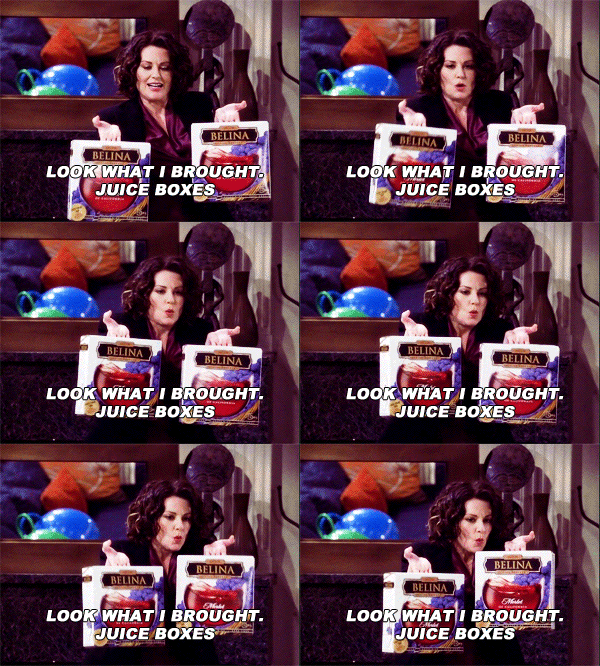
When I was 21 years old interning for a boutique PR firm that specializes in Champagne and Burgundy I would go to work and pour 2003 Blanc de Blanc Champagne and be able to try some of the rarest wines in the world. Then I would go hangout with my friends on the weekend and “slap the bag” with some Franzia white wine. The juxtaposition of my life at the time still makes me smile because it is the time I was falling in love with the world of wine. It was also the time where I started thinking, can’t we have both? Why can’t I love a 2015 single vineyard Napa Valley Cabernet Sauvignon and also love Bota Box Red Wine Blend?
The reason boxed wine is cheaper is because the companies are saving money on overhead materials by not having to buy the bottles, corks, screw tops, and machinery to make all of those things come together. The wine quality in boxed wine can be good (not great, I’m not that far removed from reality). The wine used in boxes is often produced in massive quantities and using grapes from many different vineyards within one box. However, that practice is also found in a lot of the wine bottles you buy – two buck chuck, big name cheap brands, etc. I think part of what is missing in those boxed wines is the complexity of flavors that can come from single vineyard, or barrel-aged wines.
So what’s the consensus? Drink wine out of whatever vessel you want. Next time you second guess bringing boxed wine to a party, don’t. Use it as a chance to educate your friends on different wine vessels. Maybe their expensive Chardonnay will be corked and they’ll come crawling to you for some of your wine.
Thank you for sticking with me during my time away and thanks for continually giving me inspiration during that time to continue with this hobby that brings me such joy.
Let me know what kind of ramblings you’d like to see next. Until then, cheers!

 Grape & Grub